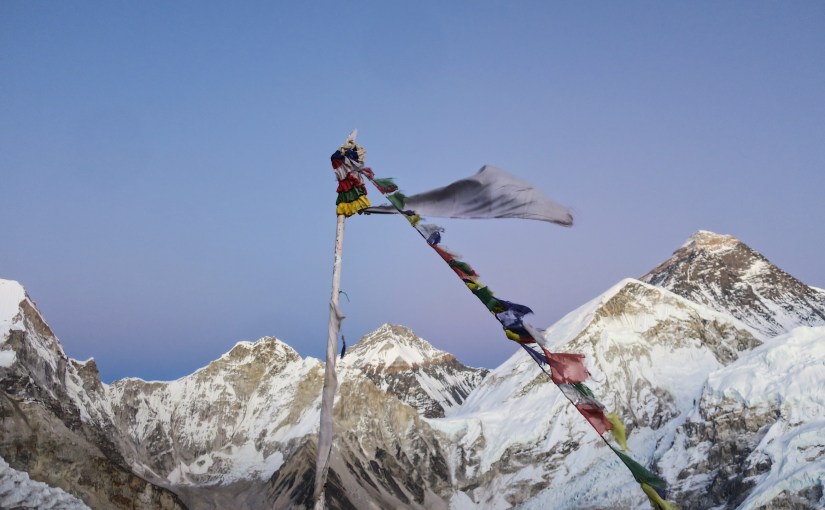
Following in the footsteps of Tenzing Norgay Sherpa and Sir Edmund Hillary.
This trek I did in the Khumbu region is hands down the most amazing hiking experience of my life, and I could not recommend it enough. I am a habitual ranker. I rank everything. My favorite food, favorite countries, favorite rappers (Black Thought from the Roots, this isn’t even an opinion, he is the actual best, see examples: 1, 2, 3, 4, 5), and of course my favorite hikes, and this is it.
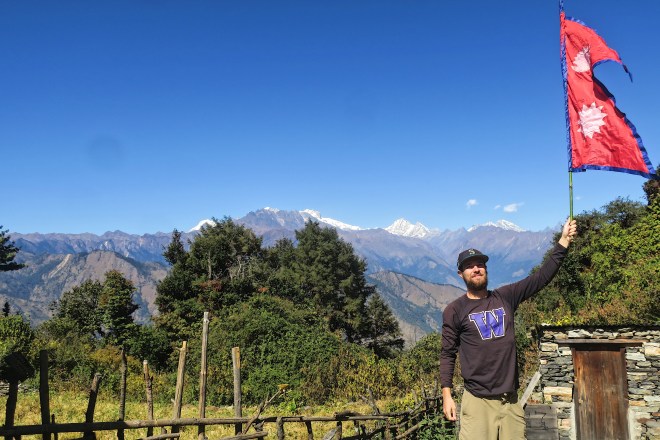
After trekking in Langtang and the Annapurna region (also in Nepal, and amazing), I still held the John Muir Trail in California as my favorite hike of all time. That is until I trekked in the Khumbu region. The views are stunning and better than anywhere I saw in Nepal. The Buddhism is fascinating and inspiring (it is actually illegal to kill animals in the Khumbu region, past Lukla). The stupas (a statue containing religious relics, used as a place of meditation), monasteries, and prayer walls were inspiring. The people were incredible. I also loved the time of year I chose to do this hike. I had clear skies and sun for the vast majority of the hike, and relatively empty trails. What more could you want?
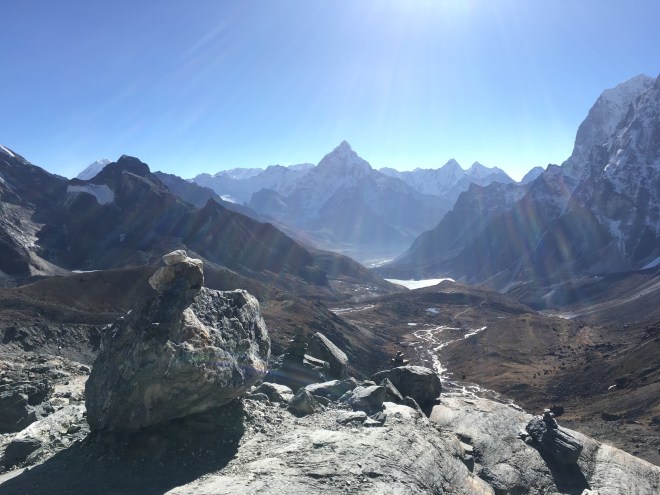
The side trips are almost endless. The variance in scenery is unparalleled. Everything from lush cloud forest, moon like landscapes, and towering mountain vistas are all available on this trek. Solitude can be had at will. I spent the vast majority of my time on this trek hiking alone or with friends of my choosing. I cannot wait to come back and hike in this region again, it is truly a special place.
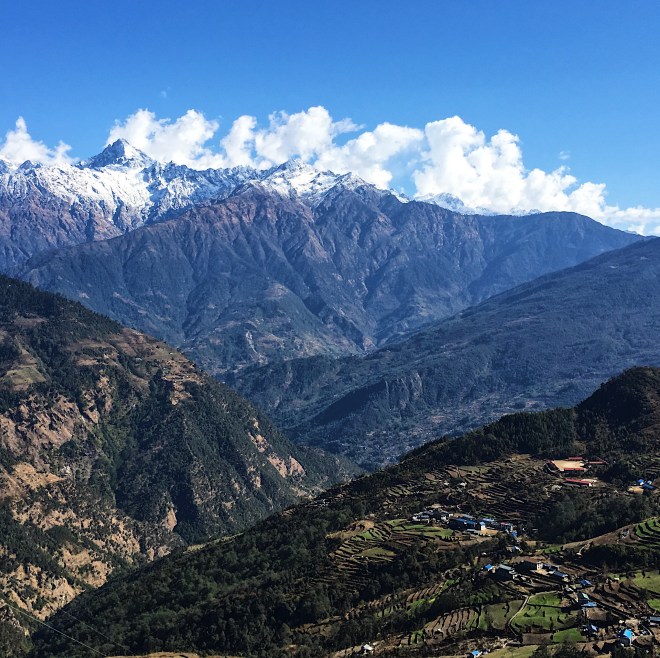
General Route & Timing Info:
My trek was a bit of a Frankenstein, combining the Tenzing-Hillary Trek with the 3 Passes Trek.
The Tenzing-Hillary Trek begins in Jiri and ends at Everest Basecamp (as opposed to flying in to Lukla and hiking to Everest Base Camp, the more popular and shorter Everest Basecamp Trek). Beginning in Jiri adds anywhere from 5-8 days to the trek, but Sir Edmund Hillary and Tenzing Norgay Sherpa had to begin here, as there was no airport in Lukla when they made their historic summit. Today it is still worth it to begin here, as the scenery and culture are incredible, and solitude much easier to find than higher up.
The 3 Passes Trek starts the same as the Lukla – Everest Base Camp Trek mentioned above, but adds 3 high passes to cross on the way, and makes the trek more of a circuit, as opposed to an out and back. The trail breaks east before Everest Base Camp, crosses Kongma La Pass, hits Base Camp, then continues over Cho La Pass, Gokyo Lakes, and finally Renjo La Pass, before rejoining the original Base Camp Trail in Namche Bazar.
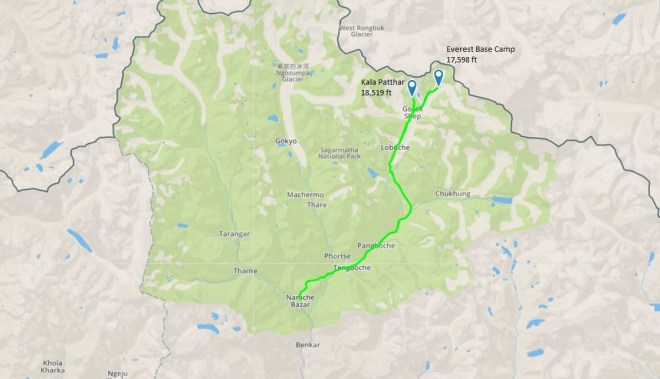
My route can be seen below. I started in Jiri, hiked straight up to Everest Base Camp (skipping Kongma La Pass due to timing and weather concerns), then continued on the 3 Passes Trek over Cho La Pass, Gokyo Lakes, Renjo La Pass, then back into Namche Bazar, where I backtracked almost all the way back to Jiri.

Interactive map
My Nonexistent Plan
I had an ambiguous and loose schedule by design. I was given extensive information and inspiration by Seth Wolpin, who is also hosting this write-up at Himalayan Adventure Labs. Without Seth’s guidance, this hike, or write-up would not have happened. Thank you Seth! I set off with a few hundred dollars in rupees, my gear, and a very general idea of timing. If this works for you, I highly recommend it for a few reasons:
- Elevation gain and distance are different in the Himalaya. I am a monster in the Sierra Nevada or Cascade Mountains in the USA. I’ve had single days with 30 miles or over a mile of elevation gain on some of my previous hikes in California with relative ease. None of this translates in Nepal (for me at least). The trail conditions are rough and elevation can have unpredictable effects, even on the same person, after extended periods of time at high altitude.
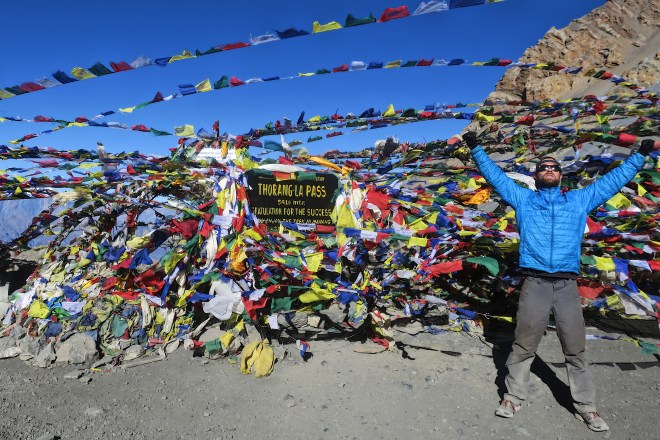
- Sometimes you meet people you want to hike with, which will always change plans.
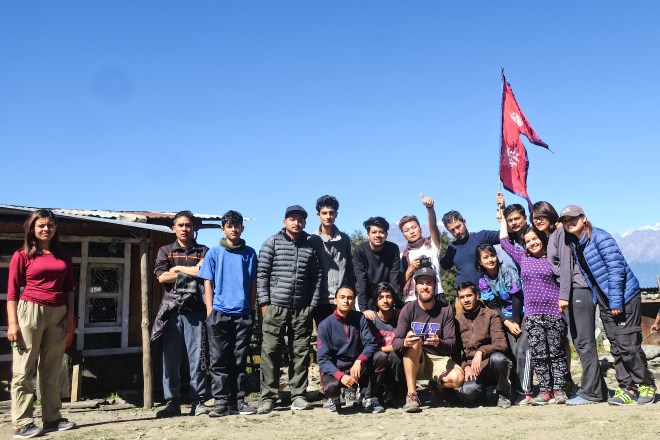
- There were days where I got somewhere so dope, I had to stop for the day, even if it was noon. I never would have known where these places were until I saw them myself.
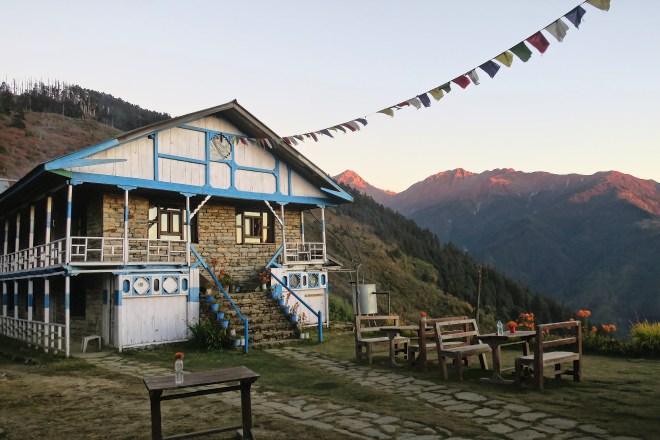
For these reasons, I really suggest a loose plan, and to just follow your heart. Nepal works best that way.
Total Days on Trail: 26
Rest (Zero) Days: 5
Total Actual Trekking Days: 21
Weather
Hiking in the Himalaya during the middle of winter can be scary! This isn’t a very popular trek to do in late December, so finding a lot of first hand information was tough. A mutual friend had done it the previous year, and gave me a ton of great information, and reassured me it was possible (thanks Emma!). With the weather stats I got from Everest Weather (full disclosure, this is my dad, but he’s amazing at what he does, and has never failed me on any of the skiing or hiking forecasts he’s given me over the years), and the below gear, I was mostly very comfortable.
I had pretty much perfect weather the whole trip. The days were almost exclusively sunny, clear, and warm enough to hike in single layers (it does get colder and windier on the really high passes, but still totally manageable). The nights were very cold though. Within minutes of the sun setting, the temperature drops dramatically. I was doing laundry and taking a bucket shower in Dzonglha (15,846 ft), on a reasonably warm and sunny day (warm enough to take a bucket shower outside) and had hung my clothes up to dry in the sun. Minutes after the sun had dropped below the mountain, my clothes were frozen solid.
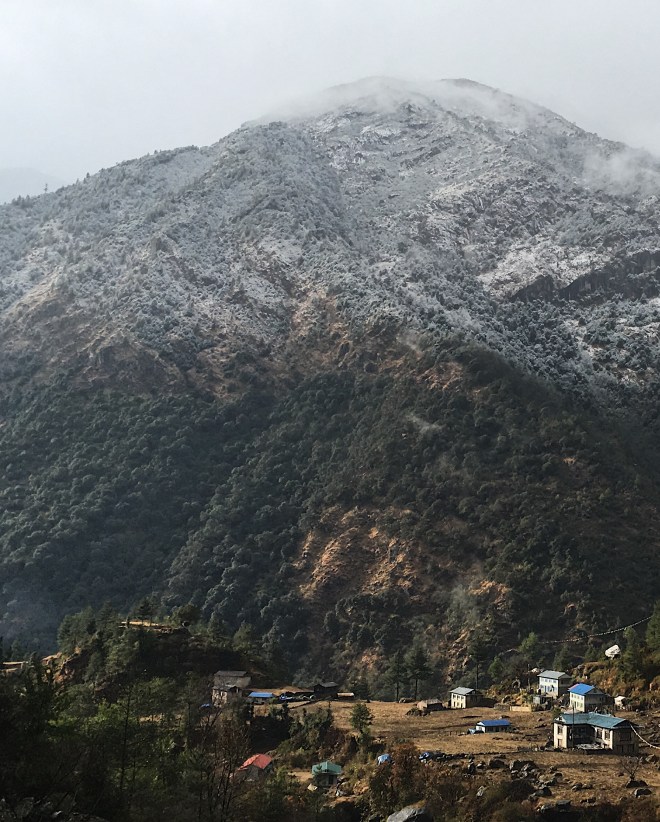
I did get a little snow right around Christmas (even this atheist Jew can appreciate a white Christmas!), then a lot more once I got past Lukla and got into Phaplu in January. Aside from that, it was clear and gorgeous every single day, and freezing at night (but clear with amazing stars and lit up mountains). I would (I actually will) come back this same time of year to hike again. It was pretty much perfect.
Gear
*Purchased in Kathmandu.
It won’t be high quality or even real, but it’s cheap, and if you’re traveling, a nice option so you don’t have to lug around a ton of cold weather gear. You can find anything you will need for trekking or climbing here, I just wouldn’t plan on using it again, because it is all mostly shit. Also a great option if you are a moron and leave your trekking poles in a jeep, as you can buy new ones for like $3.
- Short sleeve synthetic shirt
- Long sleeve UW Under Armour synthetic shirt (GO DAWGS)
- Patagonia trekking shorts
- Jack Wolfskin trekking pants
- Patagonia Nano Puff jacket
- I love these jackets, and they are mostly great, but this was inadequate for this hike for this time of year. I was fine during the day, but spending time outside after sunset was a bit uncomfortable. I should have purchased a real down jacket in Kathmandu.
- This jacket has since been destroyed in a motorcycle accident. RIP baby blue Nano Puff.
- Marmot PreCip lightweight rain jacket
- Heavy weight fleece*
- Heavy weight merino wool tops and bottoms
- Mid and heavy weight wool socks
- Synthetic trail running socks
- Wool cap
- 2 pairs Exofficio travel boxer briefs
- Glove liners
- Heavy weight down over-mits*
- Crampons*
- I bought mine in Namche Bazar to avoid carrying the extra weight until I needed them
- More like Yak Traks, very necessary for Cho La Pass; I sprung for the nice pair, maybe $20
- Marmot Helium 15 Degree bag (I did not bring it on the Annapurna Circuit and had enough blankets every night. This was in November and much lower. I was very happy to have it on this hike.)
- Trekking poles*
- 2 Maps*
- 2 maps must be purchased for this trek, as it is not a traditional trek. I used one map for the Jiri to Everest Base Camp section, and purchased a separate 3 Passes map.
- Brooks Cascadia trail runners
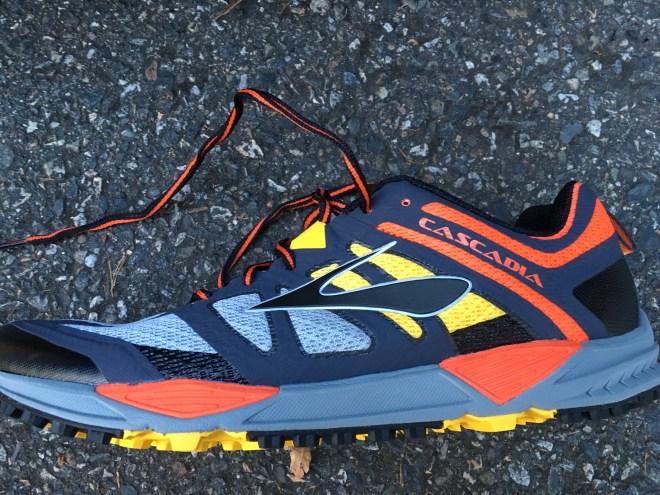
- Mariners baseball hat (Very important. GO MARINERS!!)
- iPhone
- Kept in airplane mode, using only maps.me (previously downloaded Nepal maps) as a reference
- Anker 20,000 power bank (charging costs money, so I was very frugal with my phone usage)
- Music
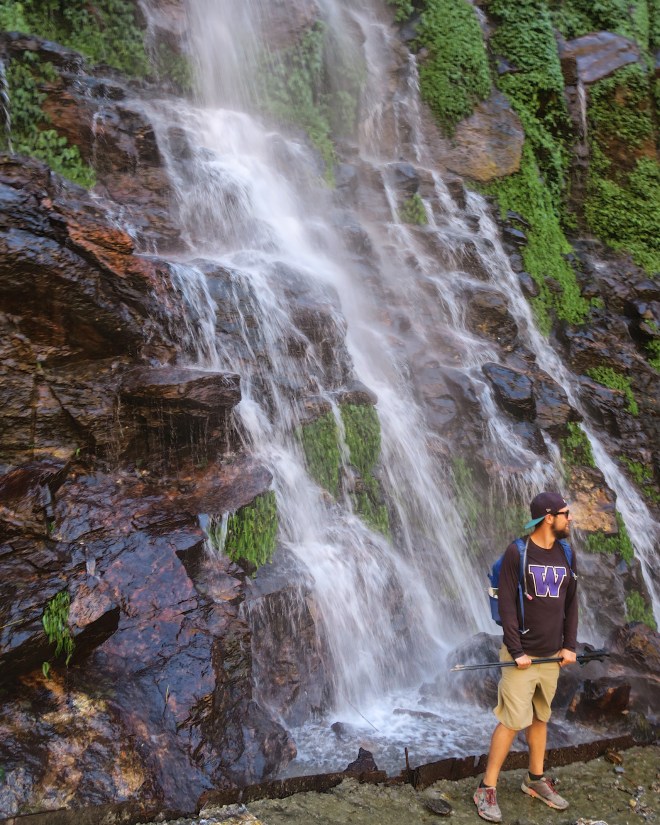
Music

I really like music when I hike. Wifi costs money on this trek, so I downloaded everything I wanted to listen to before getting to Nepal (even in Kathmandu the wifi isn’t great). I use Apple Music (for those Drake and Future exclusive releases!). If you care about my (mostly terrible) taste in music, see What I’m Listening To (a work in progress, and will be updated when I feel like it).
Reading
I read a ton on this trek, as the sun set early and the nights are cold. I prefer hard copy books, since wifi and power are in short supply, and there are plenty of book stores that will sell and sometimes buy/trade in Kathmandu and Namche Bazar. Other trekkers are also happy to trade or give away books to shed weight, and some guesthouses even have book exchanges. I typically like to read books that are relevant to what I am doing or where I am traveling, as it adds to my experience. There is no shortage of amazing books about Nepal, climbing in the Himalaya, or just hiking in general. These were my favorites, and can be found in any bookstore in Kathmandu or Namche Bazar:
Snow Leopard
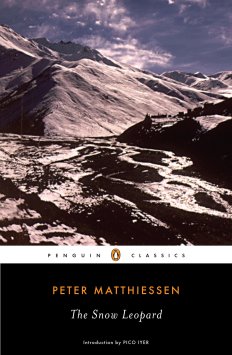
Peter Matthiessen is a travel author and zen Buddhist, who treks with his friend, a biologist, in search of Blue Sheep, Snow Leopards, and Yeti* in the Himalaya. He writes about trekking, but also about Buddhism, local culture (Sherpa, Tibetan, Nepalese), grieving, biology, and Yeti! This was kind of a challenging read, it took me 100 pages to really get into it. But I loved it. It taught me a ton about the region, biology, and culture I was immersed in. It was also beautifully written and informative, and is also just a cool story about an amazing trek that lasted months, and is way tougher than anything I will ever do. This is a must read if you’re trekking in Nepal.
*The Yeti, a giant pre-human primate (think Bigfoot, but in the Himalaya), is a huge part of Nepali folklore, and still a big part of the culture today. Scientists generally agree that the Yeti doesn’t exist, but there is a Yeti scalp on display in a monastery in Kumjung, and there have been sightings by many reputable mountaineers, like Reinhold Messner, and even Sir Edmund Hillary himself!! Matthiessen also provides some interesting opinions on the issue in his book. I am not saying they definitely exist, but they probably do.
Touching My Father’s Soul: A Sherpa’s Journey to the Top of Everest
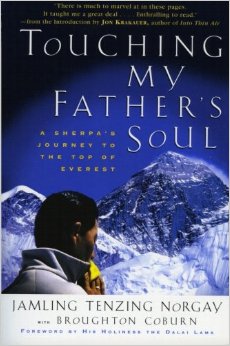
This is a great book written by the son of the first person to summit Everest with Sir Edmund Hillary. This was so cool to read, as I was literally walking in Tenzing and Hillary’s footsteps to reach Everest. It has more great insight into Buddhism and Sherpa culture, as well as a first hand account of the 1996 disaster on Everest. Jon Krakauer basically said it was better than his own book on the same disaster (see below, also a great book). It’s absorbing, hilarious, endearing, and a really easy read. I think I crushed this book in like 3 days.
Into Thin Air: A Personal Account of the Mt. Everest Disaster
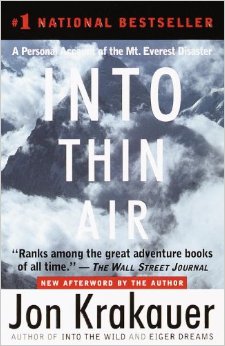
Required reading for Nepal, by one of my favorite authors. I read this book when it first came out, and is one of the reasons I ended up in Nepal. I love Krakauer’s writing style. It is so engaging and down to earth, yet he is so knowledgeable. In my opinion, he is the gold standard of adventure/climbing/hiking journalism. The story itself is tragic, but a great learning experience for anyone looking to venture into the mountains.
Into the Wild
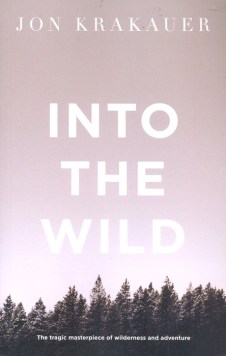
Another classic by Krakauer. Krakauer is sympathetic to McCandless’s tragic (yet kind of inspiring) story, and this definitely shows in the book. Where the movies paints McCandless as some young, spoiled idiot (by leaving out key facts that Krakauer reveals in his book), Krakauer shows us that McCandless was simply a lost, sensitive, and while arrogant, honest person escaping a world he didn’t understand, in search of something real. This book taught me more about myself than anything I’ve ever read, and might be one of my favorite books of all time. It’s also like a 100 pages. Read it.
Transport

Kathmandu -> Jiri
• Local bus from the Old Bus Park, close to Thamel, direct to Jiri
Phaplu -> Kathmandu
• Local bus, organized through my guesthouse in Pahplu
I do not remember the cost of the bus, but it was an insignificant amount of money, and I am sure changes frequently. If you buy your ticket directly from the bus park in Kathmandu, or from a trusted guesthouse owner (pretty much anyone, especially once you leave Kathmandu), you will get a fair price. This is the cheapest form of travel in Nepal (for good reason).
Fees/Costs
TIMS Card: $20
Gaurishankar Conservation Area $20
Sagamartha National Park: $33.90
In true Nepali “figure it out as you go” fashion, I purchased all of these on the trail, very easily, at no additional cost. I think this is the better option than navigating the tour and sales offices of Kathmandu. I didn’t even need to know where these offices were located, as the National Park and TIMS officials waived me in off the trail, to either check my permit, or sell me the required one. I was never over charged, and always offered friendly conversation and advice.
Daily Budget: $30/day
• This budget allows for 3 meals a day and lodging, but does not include the above permits
• This could be done for less with some creativity and frugality, or more if you like to indulge in candy, beer, or western food

A note about ATMs:
• The only ATM on this trail is in Namche Bazar. There could be ATMs in either Jiri or Phaplu, but neither are much help as they are at the very beginning or end of the trail
• The power and internet were out in Namche Bazar for almost a week, stranding me there as I had run out of cash. In Nepal, you can always figure things out (my hotel let me run up a tab until the power came back on). It would be best not to rely on this ATM, and just bring 25%-50% more cash than you think you’ll need
Food
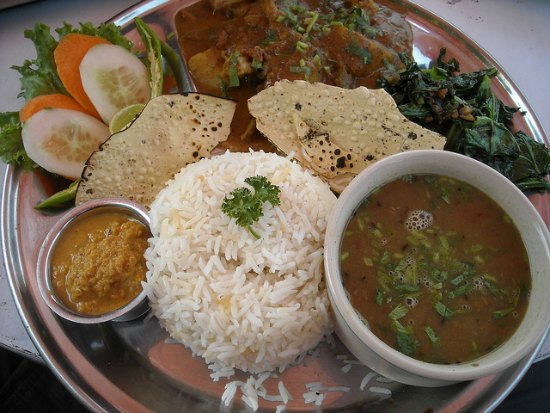
I have been traveling for months now, from South America to all over Asia. Nepali food is hands down my favorite of all the countries I have been to. It is simple, healthy, very veg friendly (you typically have to try to have meat, most of the food is vegetarian or even vegan by default), tastes amazing, and somehow doesn’t ever get old. It is the perfect food for trekking.
Dal bhat is pretty much the national food of Nepal, and is commonly eaten for lunch and dinner. It consists of rice, lentil soup, curried vegetables and potatoes, some greens, and some pickled/spicy vegetables. I ate this every single night of trekking (around 2 months), plus half of my non-trekking time in Nepal. It never got old! It was a little different everywhere I had it. The only thing consistent, and my favorite part about it, is you always get more! Sometimes it’s just seconds, but typically they will offer you more until you beg for mercy. I have put down 4 servings of this stuff in one sitting. The highlight of every night of trekking was inhaling as much of this stuff as I could before they came around offering seconds. I am not a disgusting glutton, I promise. When you hike all day, you burn a ton of calories. Hiking at high altitude requires even more energy, as does staying warm during the cold nights. That is why dal bhat is perfect for trekking. It has carbs, protein, greens, and it’s bottomless!!
There are various forms of Western/Chinese food available in all the tea house I stayed at. But none of these were bottomless (this isn’t Golden Corral), so in the end more expensive. I also didn’t come all the way to Nepal to eat shitty pizza for dinner.
Guide
I am a big fan of trekking independently. I love the freedom it offers, and as a budget traveller on a very long trip, this was my method of travel for all of my treks in Nepal.
That being said, when I go back, I will absolutely be hiring a guide. On all 3 of my treks, I witnessed first-hand the guide community in Nepal, and it is fantastic. They are well trained, knowledgeable, and just fun to hang out with. They are well worth the relatively low cost they charge for their services.
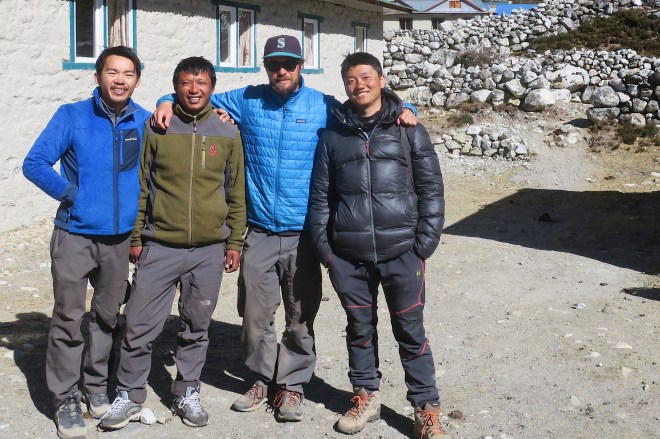
I hiked extensively with one guide and his clients in particular (I didn’t hire him, they just invited me along), and would definitely recommend him. His clients raved about him, and I had a blast hiking with them. He was very knowledgeable about local tradition and culture, hiking and the mountains, and flat out one of the friendliest and most genuine people I met in Nepal.
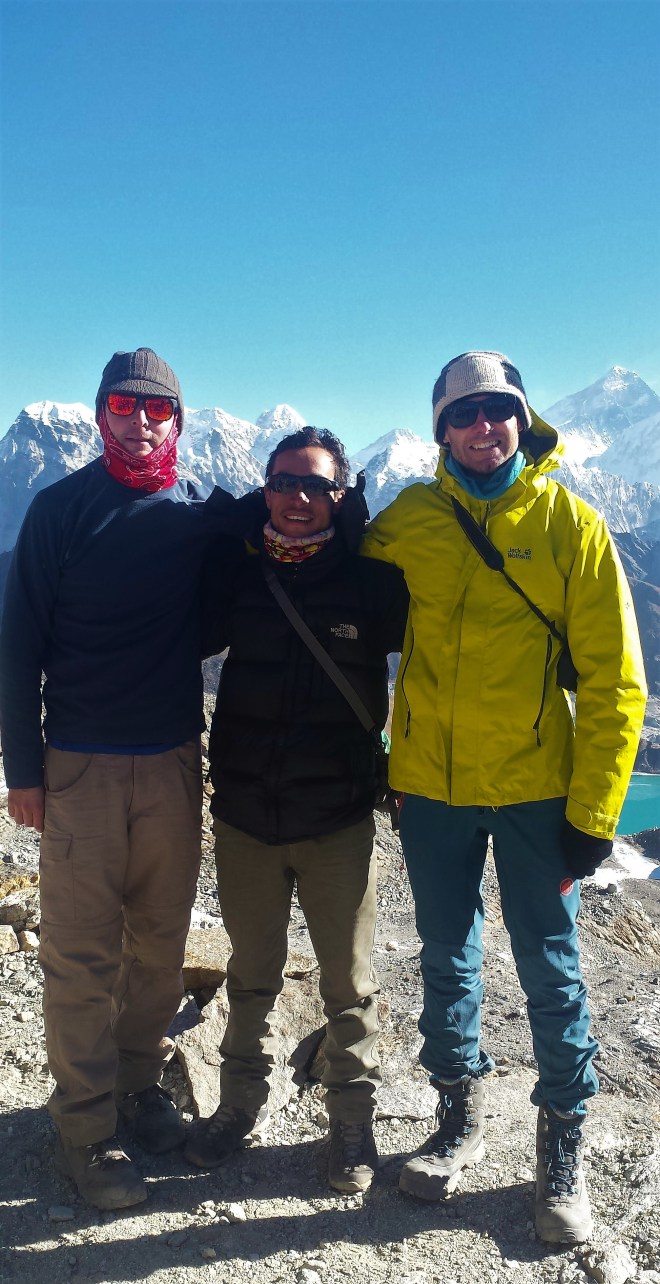
Bishnu Lamichhane
Funny Nepal Treks and Expedition
Getting to Jiri

I took a public bus to Jiri. This bus leaves from the Old Bus Park in Kathmandu. I went to the Old Bus park the day before to purchase my ticket and get confirmation on the timing. They leave very early in the morning, and although I was told they run until 8 am, I opted for the 5 am bus just to be safe. We were also budgeting a 10 hour ride, so we wanted to get an early start. Any hotel or taxi will know where the Old Bus Park is, just make sure to clarify you are going to Jiri to leave no room for confusion.
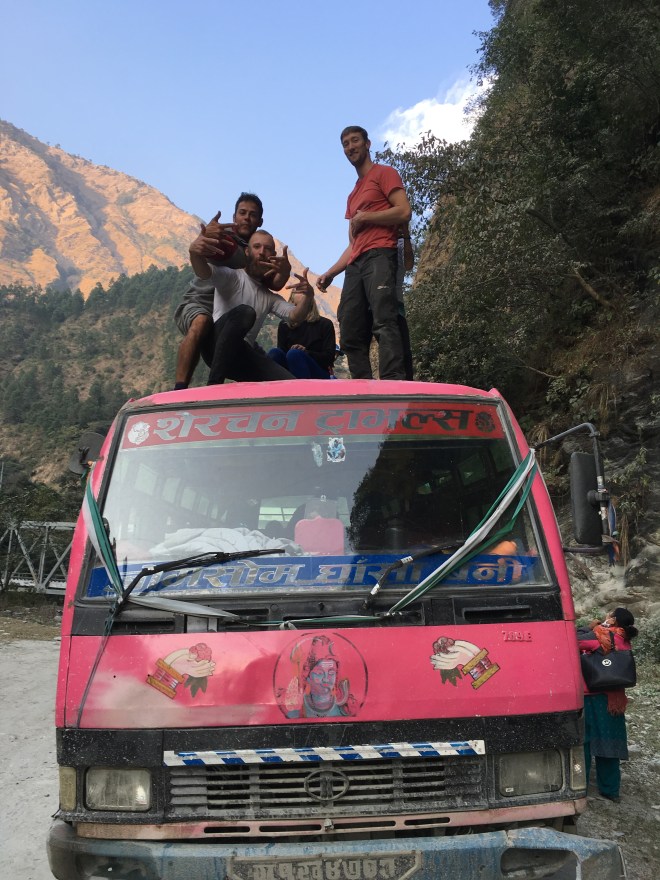
Even on my most horrific bus rides in Nepal (I’ve had some truly terrible experiences), the locals and bus drivers have always been amazing and helpful, and I have always arrived where I needed to (give or take a few hours). No exception on this route! Fun locals, great lunch stops, gorgeous views, and a relatively smooth ride! This was my easiest and most pleasant bus ride I took in Nepal. Anyone on a budget, or just valuing an interesting and authentic way to travel should have no issue on this route.
Jiri – Shivalaya (1 Day)
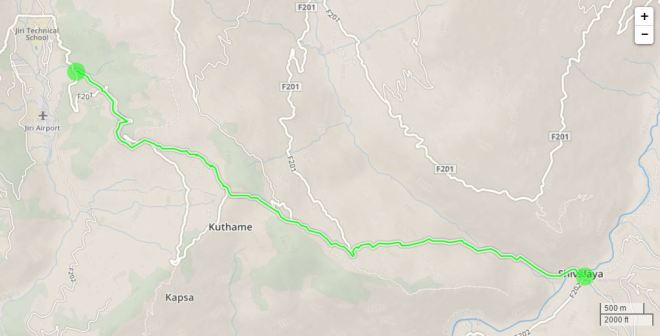
The bus took about 10 hours. We arrived in Jiri at about 3. We should have stayed there for the night, but we decided to push on to Shivalaya. I do not recommend this, as there are no guesthouses until Shivalaya, and we ended up hiking well into the night.
Shivalaya – Namche Bazar (8 Days)
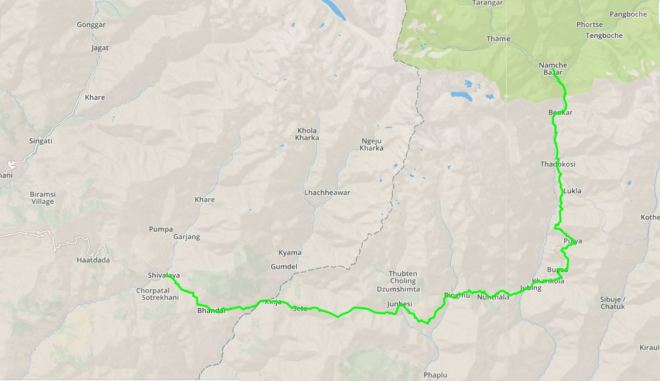
This section is not easy. The total elevation is not as high as achieved higher up on the trek, but the gain/loss is brutal, sections of the trail are pretty rough, there are donkey trains, and because of the lack of other trekkers, a map is necessary. That being said, for the reasons listed below, in addition to the training and acclimatization achieved, I would not miss this section for the world.

The section of the trail has some of the most authentic and least spoiled Nepalese culture I witnessed in all of my trekking in Nepal. It is not well traveled by tourists, as most opt to fly into Lukla. We had the trail to ourselves (aside from school children, guides hiking up to Lukla to meet clients, and the locals hiking in between villages).
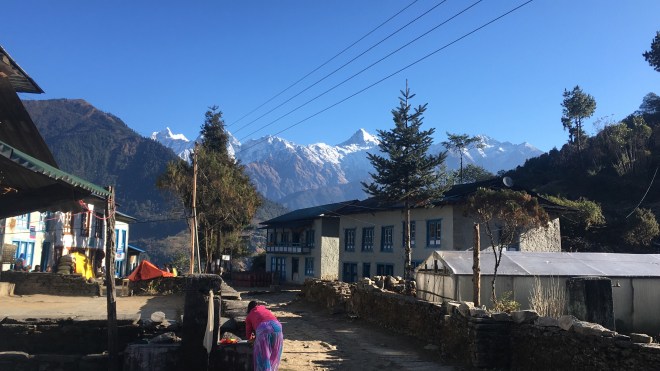
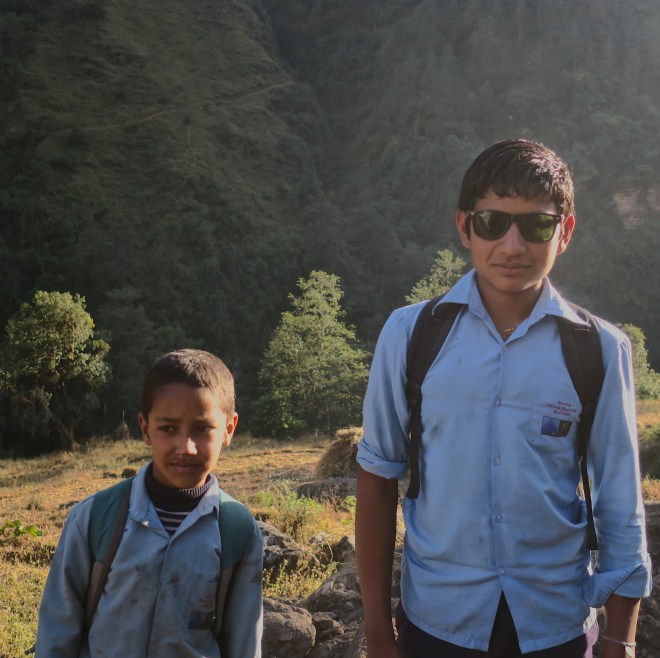
As a result of the lack of tourists, we were much more of a spectacle to the locals than I found on more popular routes. This is fun! People love to chat, ask where you are from, give you great info on your hike, or maybe just practice English! The kids were hilarious. Some of them begged around the smaller villages, and I wish I had brought some paper/pencils to give them, as it is not advised to give money or candy. But most wanted to practice English, hike with me, try on my sunglasses, and have me take pictures of them with my camera so they could see themselves (then exclaim “how handsome!”).
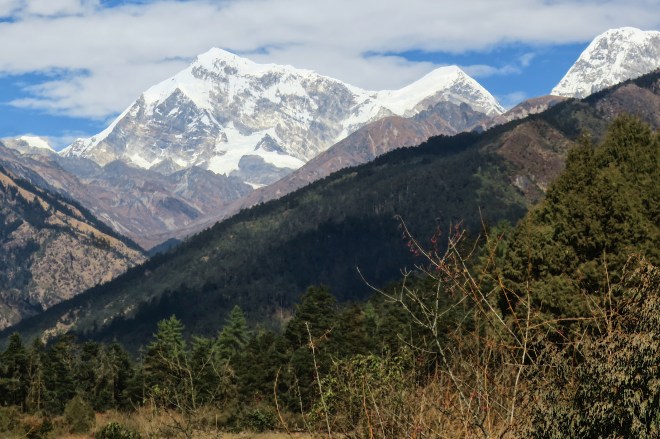
The scenery on this section is gorgeous. We hiked through lush forests, rice terraces, farm land, and up and over some passes with gorgeous views of the Himalaya. The mountain views were surprisingly great very early on. As opposed to the Annapurna circuit, where you have to hike for a few days to get the good views, Numbur makes an appearance as early as the second day.
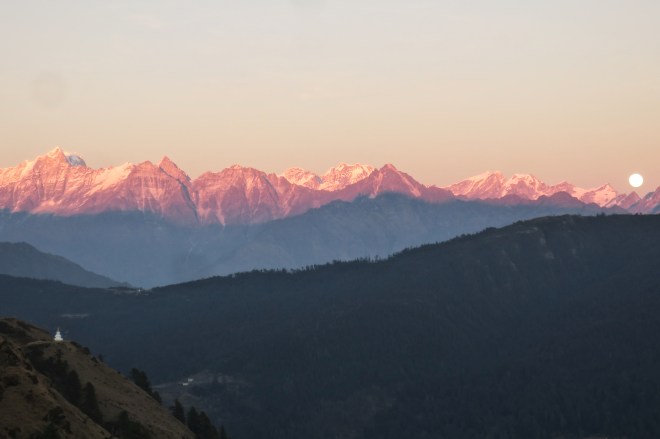
We had an amazing panorama in Phurthang, at a guesthouse that seemed to be either attached to, or the same as a cheese factory. The owners were lovely, they made incredible dal bhat, and the sunset was one of the best we got on the entire trek.
Speaking of guesthouses, my favorite one was the Khumbu View Lodge, in between Puiya and Surke. The lodge is owned and operated by Pemba Galjen Sherpa. The food and lodging were awesome, and Pemba and his family were very accommodating. They offered me the most authentic view into Sherpa culture that I had in Nepal. This included eating traditional food with their family, drinking tongba (hot wine made from millet), and hearing stories of Everest summits around a fire. The view isn’t bad either.
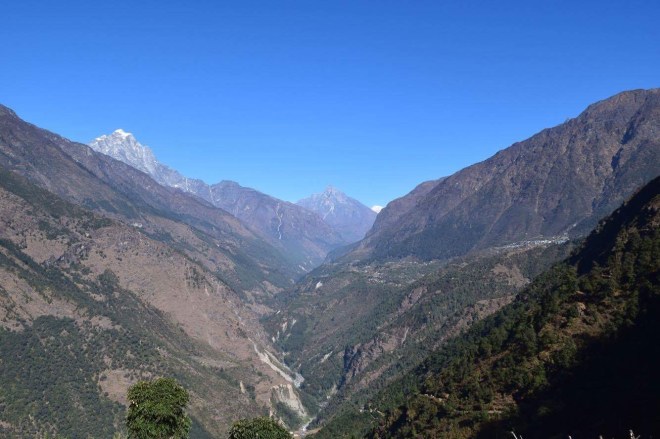
It is not necessary to hike into Lukla, as it is somewhat off the trail. I was able to hike from Puiya all the way to Namche Bazar. It is not easy, but I had already been trekking for over a month in Nepal, so I felt strong. This could easily be broken into two days.
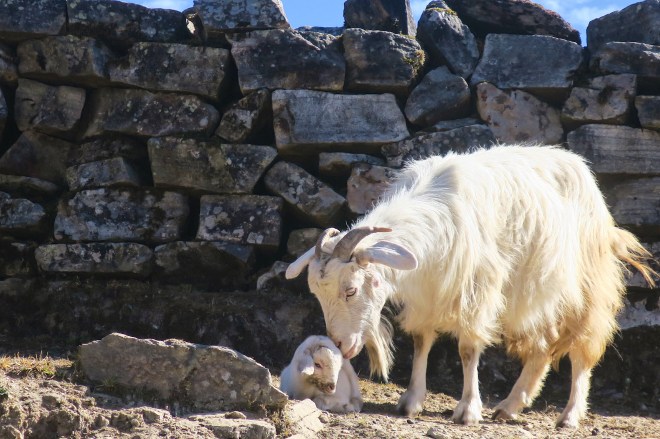
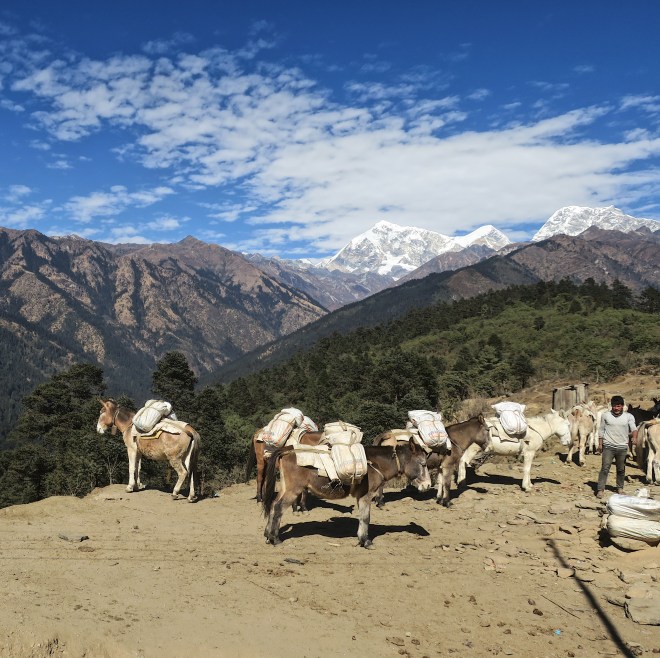
Once I got past Lukla, the trail got much more crowded, and this didn’t let up until I left Everest Base Camp for Cho La Pass. My Norwegian friend that I met on this section of the trail liked to start late and hike until sundown, as the twilight hours offered more solitude and gorgeous lighting for pictures. I found this to be a great strategy for avoiding the crowds and donkey trains.
Namche Bazar was a great place to recharge, eat, drink, buy more supplies, and rest. I bought warmer clothes and crampons here (for Cho La Pass). It can be a bit of a money pit, and I enjoyed it much more on my way down (it felt more earned). I spent two days here before setting off for Everest. I loved the Khumbu Lodge. The owner was hilarious and kind, the food was great, and they had rooms for budget backpackers like me, as well as actual hotel rooms for more short-term travelers with a bigger budget. It is also where Jimmy Carter stayed. If it’s good enough for him, it’s good enough for me!

Namche Bazar- Everest Base Camp/Kala Patthar (3 Days)
I had a really late start leaving Namche Bazar, so I only made it to Tengboche that day. There are only a few guesthouses here, all with similar accommodation. The monastery is gorgeous and the view was great.

From Tengboche I hiked all the way to Lobuche, taking the high route above the canyon, and skipping Dingboche. The views on this trail were stunning, and felt like a truly alien world.
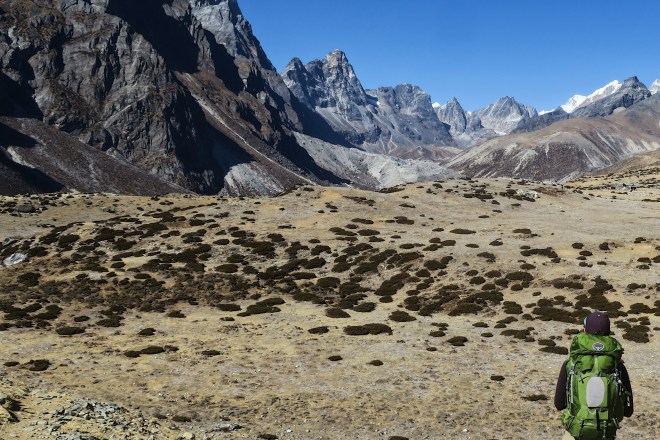
There is a memorial for fallen climbers right before Lobuche. It was a very powerful experience, and should not be missed.

From Lombuche to Everest Base Camp can easily be a full day, but I opted for tackling Kala Patthar as well. This was a tough day, but worked out perfectly. I left most of my gear at the guesthouse in Lobuche (TO EBC Guesthouse, very nice kids, one of which actually hiked with us to basecamp just for fun!), hiked to Everest Base Camp, came back to Gorak Shep to get a room and lunch, then hiked up to Kala Patthar for sunset, leaving around 2 pm from Gorak Shep.

We stayed on top well into sundown, and had to hike down in the total dark, but it was absolutely worth it. Bringing a thermos of hot tea helped (thanks Paul!).
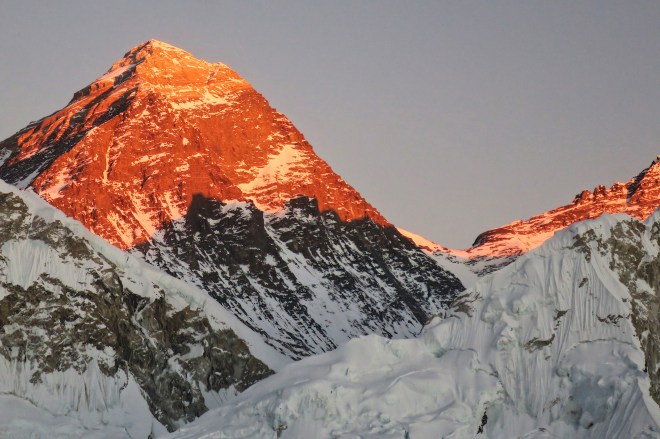
I met many people who skipped Everest Base Camp. I have to admit, compared to the other views, it wasn’t the best. If timing is tight, it could be skipped in lieu of Kala Patthar. However, if possible, I would definitely recommend both. While the views from Everest Base Camp aren’t stunning, you are standing in the middle of the Khumbu Ice Fall. It is majestic and the power is tangible. I loved it, and I am really glad I made the trip.
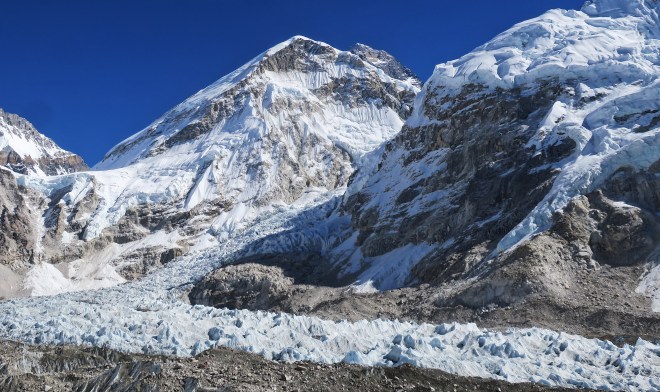
The trail to Basecamp can be a little tricky. It wasn’t well marked, and during the off season, there isn’t a lot going on at Basecamp, so it can be easy to miss. Luckily I had a guide, who worked for head scratches and coconut biscuits.
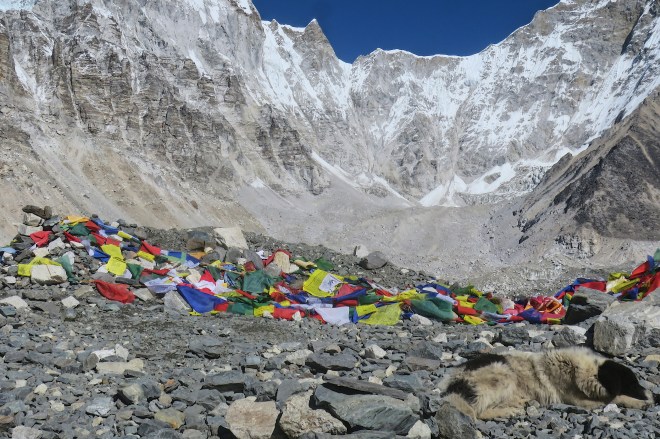
Lobuche – Cho La Pass (2 Days)
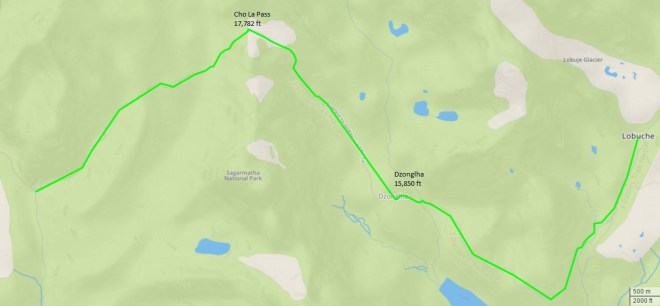
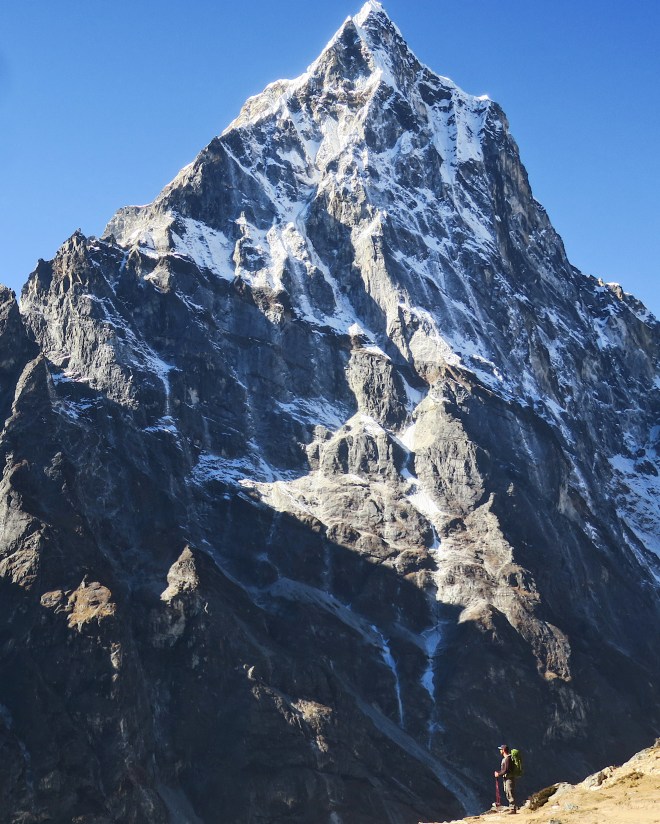
Another late start held us at Lobuche for another day, as we were all tired from the monster day we had before. From Lobuche we hiked on an absolutely surreal trail to Dzonglha, which serves as a basecamp for Cho La Pass. This was a short day, but it worked out well because the views and surroundings are amazing, and we spent a ton of time taking pictures and just being in general awe.
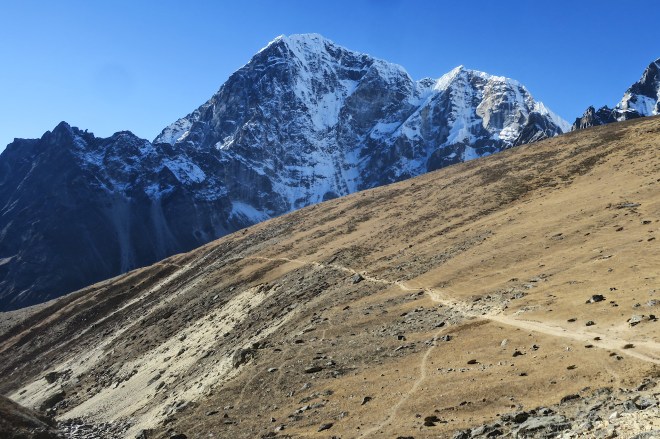
That night was spent discussing Cho La Pass, which would be attacked the next morning.
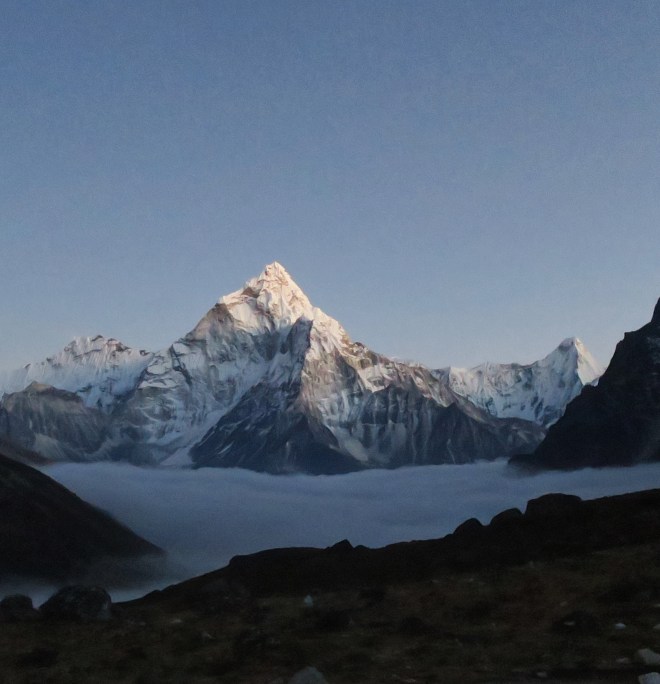
A word of caution about Cho La Pass. It is recommended to do this pass with a guide, or at the very least with a group. I have done some mountaineering, and was hiking with a couple of dudes I met in Gorak Shep (turned out to be great dudes, and literally saved someone’s life!), so we did not feel the need to hire a guide. At the very least, you absolutely have to have “crampons” (which can be purchased in Namche Bazar), and should not be alone. It will always require glacier travel, and when we crossed, there was no cover snow at all. It was all ice. Case in point:
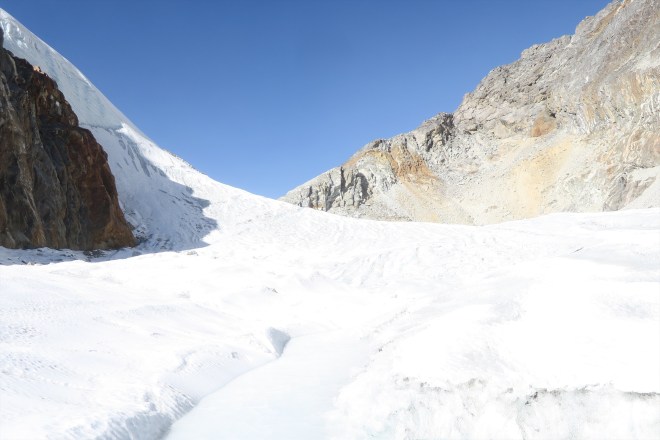
A very nice couple we met in Dzonglha had been hiking together, without a guide. They opted to follow the multiple groups of people over Cho La Pass. The group in front had a guide, and the rest of us broke into smaller groups and followed them. The couple, along with my 2 friends from Gorak Shep, were the last over the pass. I saw them cross the glacier, pointed out my path to them, then descended quickly, as I was starting to really feel the elevation and was a bit worried about my health. I got to the first guesthouse I saw and ate lunch. 30 minutes later my friend Paul ran in saying the woman hiking behind them had fallen off the glacier and injured herself. Her and her boyfriend were stuck on the glacier, with our other friend, waiting for some kind of help. The descent off of this pass is sketchy and dangerous with healthy legs, it would be impossible to do if you couldn’t even walk (she couldn’t). We did not know if they had insurance for a heli ride, the sun was starting to set, and we had already had one of the toughest days of hiking on the entire trek.
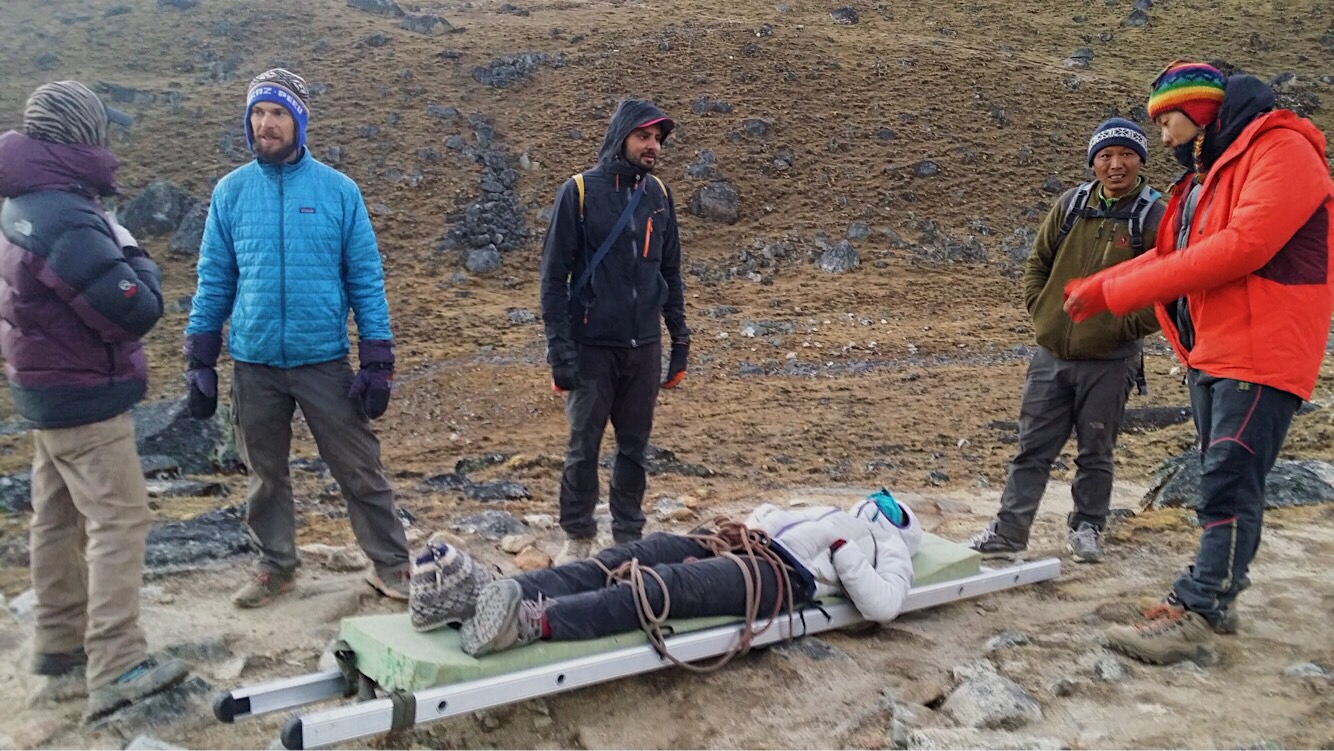
As luck would have it, I just happened to eat lunch at a guesthouse owned by Pemba Tenzing Sherpa, one of the toughest human beings on this planet. He grabbed a guide who was playing cards with a client, and the 4 of us set out as the sun was setting, up the pass we had just come down. We found our other friend first, as he had left the couple when the sun started going down. At dark, we found the couple, and loaded the woman onto a stretcher that Pemba had made out of a ladder. The 5 of us rotated on the back of the stretcher, while Pemba manned the front himself, stopping only to smoke (Sherpa oxygen!). The woman was in good spirits, but freezing. The temperature drops dramatically at night, and the only reason we weren’t also freezing was because of all of the hiking. Pemba eventually grew impatient with the pace and put the woman in a harness, strapped her to his forehead (porter style), and ran the last mile down the creek bed back to his guesthouse. Everyone got back safely, and the couple was helicoptered out to Lukla the next day. Crossing glaciers is no joke, and mistakes can have huge consequences at 17,000 feet. Luckily Pemba is a real life super hero, so everyone ended up ok.
Cho La Pass – Gokyo Lakes – Gyozumpha Tsho (2 Days)
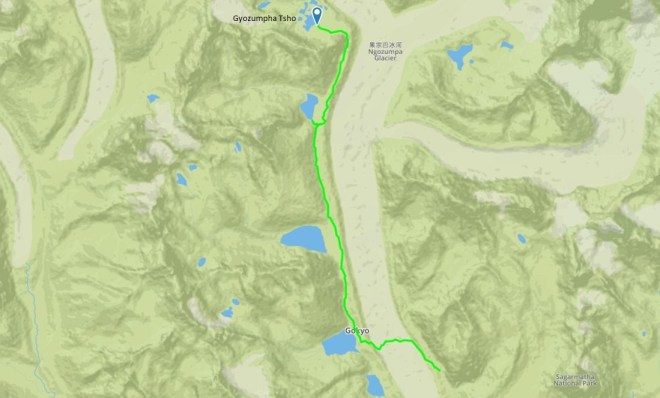
The hike to Gokyo is tricky, as you have to cross a giant glacier. It is also awesome, because you have to cross a giant glacier!
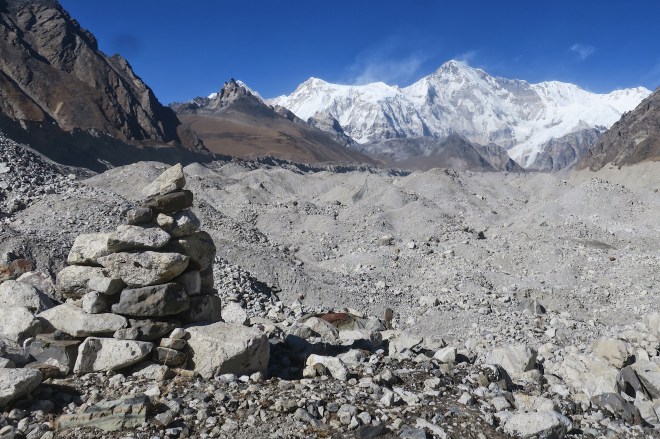
This glacier is covered in scree, so no crampons are necessary, but the hiking is slow. Luckily the views are insane, and the glacier makes a very eerie noise as it carves its way through the valley. The approach into Gokyo Village gives you a fairy tale vista, as a collection of guesthouses surround a gorgeous glacial lake. We stayed at the Gokyo Resort for a few days and loved it.

The next day we made the hike to the last lake in the series of Gokyo Lakes, called Gyozumpha Tsho. It was an all day hike, but the views were well worth the effort the entire time. The Gokyo glacier looms next to you the entire time. I still think the main lake, by the village, is the prettiest though.
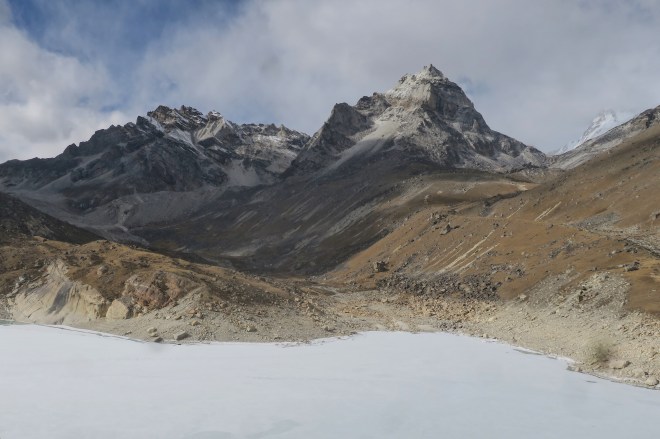
Gokyo – Renjo La Pass – Lungdhen (1 Day)
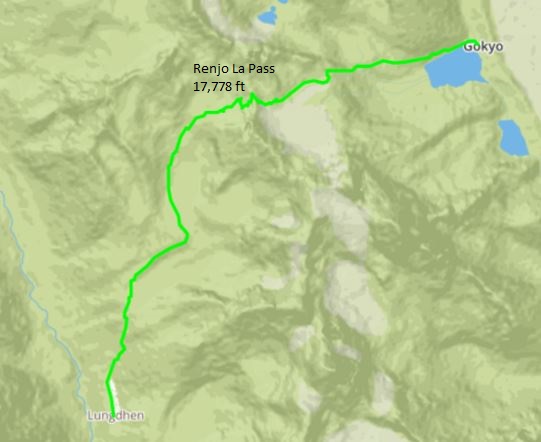
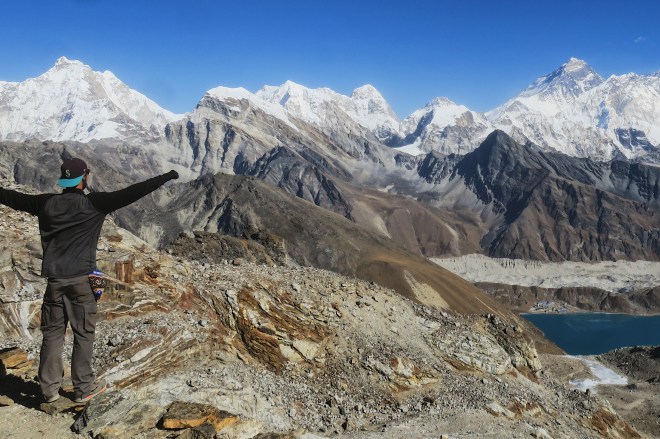
I opted to skip Gokyo Ri, a very popular side trip from Gokyo village. I wanted to start descending as quickly as possible. The weather had already started to turn, as I had gotten snow on my hike to the lakes the previous day. I was also told that Renjo La Pass offers a very similar view. The hike up was of course brutal. This trek made me earn every beautiful vista I witnessed. After a gruelling hike up, losing the trail a couple of times (always look for cairns, they are pretty consistent along this part of the trail, I just missed them), I finally got to the top.

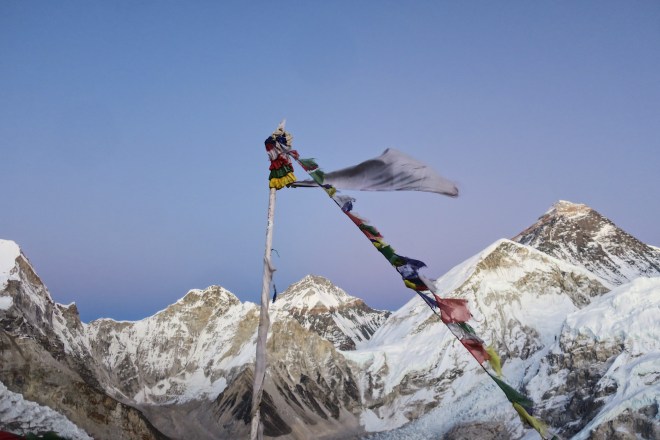
I was treated with the most impressive view of Everest I have ever seen. This was also the only view of Everest I saw where Everest appeared taller than the surrounding mountains.
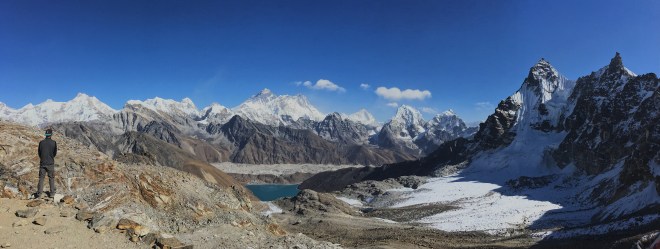
The views don’t stop on the way down either. All the way to Lungdhen were amazing vistas and surreal landscapes.
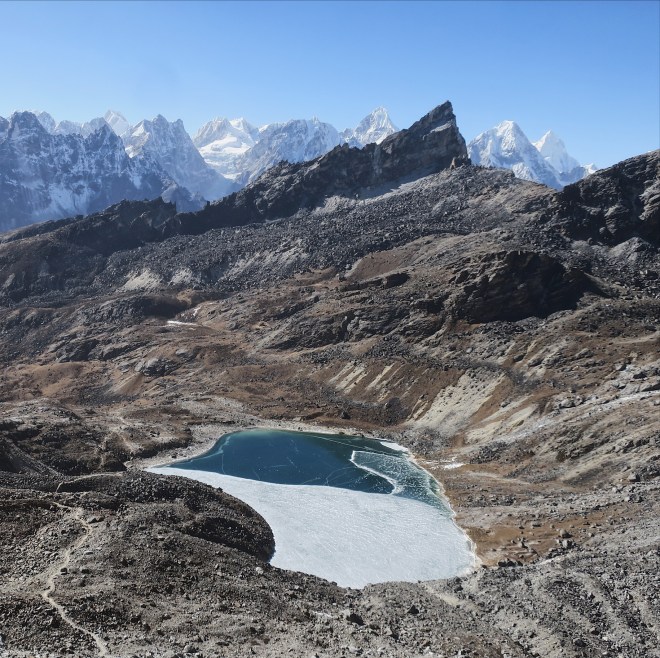
Lungdhen -Namche Bazar (1 Day)
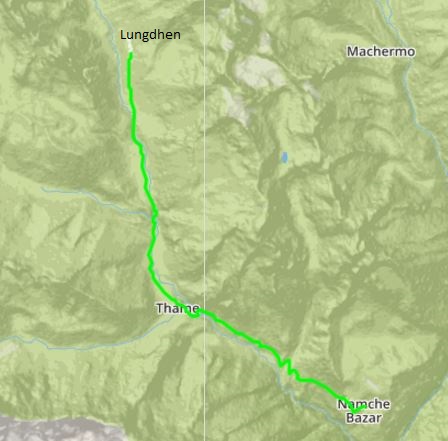
We decided to push from Lungdhen all the way back to Namche Bazar, skipping the very popular stop Thame. This was a mistake. Thame is gorgeous, has a wonderful monastery, and is the birthplace of Tenzing Norgay Sherpa, the first person (along with Sir Edmund Hillary) to summit Everest. My friends stayed there and raved about it. It was especially dumb to skip, as I ended up stuck in Namche Bazar for almost a week waiting for the power to come back on so I could pull out more cash. They were able to get the ATM working for 15 minutes a day by charging it all day with the solar panels, only to have the internet fail! Namche Bazar isn’t the worst place in the world to be stuck though, and the lovely family at the Khumbu View Lodge let me run up a tab while I ate and drank there. We also had a great NYE party in a dark bar around a fire, complete with live music and raksi (Nepali moonshine). Nepal is one of those special places where even getting stuck somewhere with no power or cash can turn into a wonderful experience.
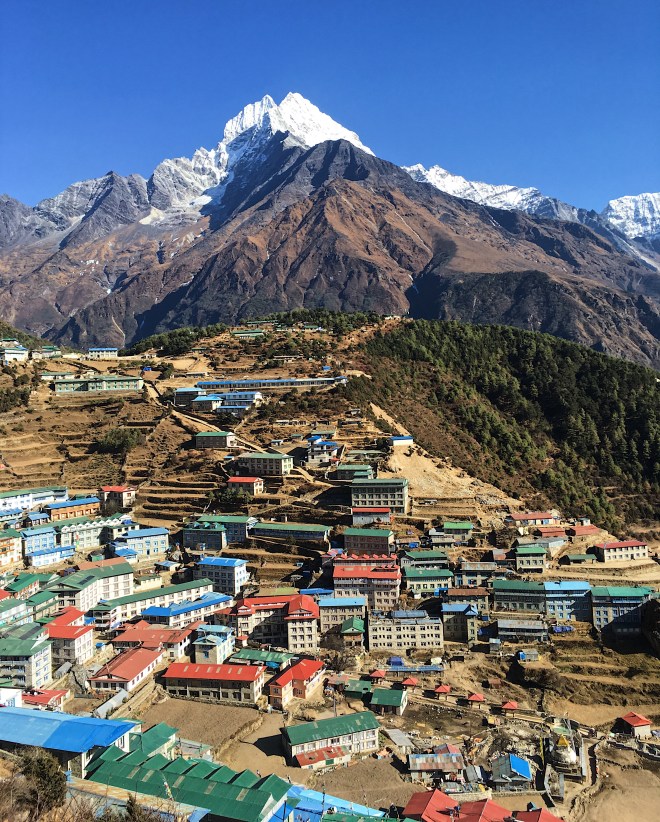
Namche Bazar – Phaplu (3 Days)
The Journey Back

The trail back to Phaplu backtracks all the way to Ringmu, where it veers off the original path to head south towards Phaplu. I stayed at my friend Pemba’s guesthouse The Khumbu View Lodge, for one more night with him, his family, and that amazing dal bhat, tongba, and towa (traditional Sherpa food I can best describe as gnocchi, delicious). Pemba was also cooking up some yak steak, from one of his animals which was killed by a tiger (or maybe a Yeti?). I passed on the yak, but I kind of wish I had tried some. From there I went straight to Phaplu in one day.
After leaving Ringmu, the trail is gorgeous, and the hike into Phaplu is just as amazing as every other inch of this trek. It was surreal seeing the first motor vehicle in almost a month! I stayed at the cheapest guesthouse I found, and had the treat of watching Nepali action movies and REM music videos with a bunch of locals, and eating more great local food.
The bus ride home was not nearly as pleasant as the ride in, and ranks up there with one of my worst (which is saying something, I’ve had some brutal ones). The window next to me was broken and permanently open, so I was freezing the whole time. Then we got stuck in the snow amid an insane traffic pile up of giant trucks, buses, jeeps and mopeds. I was forced to go handle some business in the snow on the side of the highway in front of everyone. I was also somehow colder than I was on the bus ride, which makes no sense at all. But of course, since it’s Nepal, I met some more amazing people, starred in a few selfies, and had some laughs about the whole thing. Eventually we got back to Kathmandu, and I was able to get my old room in Kathmandu, eat 5 veggie burgers, and watch the NWA movie on tv (it was really good btw).

Conclusion

 Best Coast Adventures
The information are so good
LikeLiked by 1 person